How to Reduce Generator Noise: effective ways to lower sound levels
Home >
Blog >
How to Reduce Generator Noise: effective ways to lower sound levels
A generator is a useful source of backup power, but its operation is often accompanied by significant noise. This is especially noticeable in private homes, construction sites, or when equipment is used near residential areas. If you are using industrial generators, the noise issue can be even more serious due to their higher power and intensive operation. In this article, we will look at practical ways to effectively reduce noise without compromising equipment performance.
Why a generator is noisy
The main noise sources are the internal combustion engine, body vibrations, and the exhaust system. In models such as gasoline generators, the sound is especially pronounced due to high engine speeds. In more powerful systems, including industrial gas generators, additional noise comes from cooling systems and strong airflow.
Understanding the source of noise is the first step toward effectively reducing it.
Installing the generator on a proper base
One of the simplest yet most effective methods is reducing vibration. If the generator is placed directly on concrete or a metal surface without damping, the noise level increases significantly.
What can be done:
- use rubber anti-vibration pads;
- install a platform with a damping layer;
- avoid direct contact with rigid metal structures.
This is especially important for industrial generators, which operate for long periods and generate constant vibration.
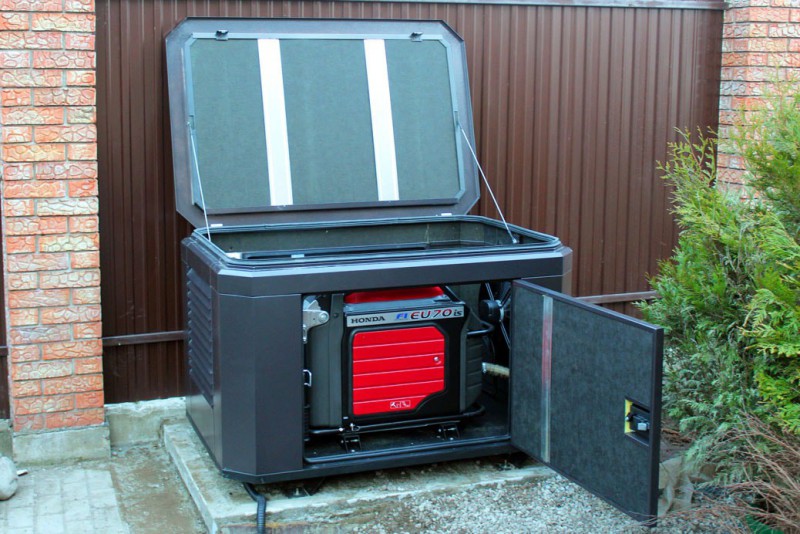
Soundproof enclosure or container
The most effective way to reduce noise is a dedicated soundproof enclosure. It acts as a barrier that absorbs and reflects sound.
For residential models, compact soundproof boxes are suitable, while for large systems such as gas generators industrial, containerized solutions with ventilation and heat exchange are used.
Key considerations:
- sufficient air circulation;
- heat-resistant internal materials;
- easy access for maintenance.
Using a muffler and upgrading the exhaust system
Most generators come with a basic muffler, but its efficiency can be improved. Installing an additional or higher-quality muffler significantly reduces exhaust noise.
For gasoline generators, this is especially important since exhaust noise is often the main sound source.
You can also:
- extend the exhaust pipe;
- direct exhaust gases away from working areas;
- install additional resonance chambers.
Remote placement of the generator
Another simple but effective approach is proper placement. The further the generator is from residential or working areas, the less noticeable the noise becomes.
This can be achieved using:
- extension cables;
- protective shelters placed at a distance;
- natural or artificial barriers (walls, embankments, fences).
This solution is often combined with sound insulation, especially when industrial generators are used on construction sites or in production facilities.
Maintenance as a noise reduction factor
Worn-out parts always operate more loudly. Regular maintenance not only extends the lifespan of the equipment but also reduces noise levels.
Pay attention to:
- bearing and mounting condition;
- oil level;
- air filter cleanliness;
- exhaust system integrity.
Even in powerful systems such as industrial gas generators, timely servicing can noticeably reduce noise.
Using modern low-noise models
If you are planning a purchase, consider modern generator models with factory-installed sound insulation. Many manufacturers now produce quiet versions that are significantly more comfortable to use.
These include both residential units and next-generation gasoline generators, which operate much more quietly thanks to improved engine and housing design.
Reducing generator noise is a set of measures rather than a single solution. The best results come from combining several methods: anti-vibration bases, soundproof enclosures, proper placement, and regular maintenance.
For large facilities using industrial generators investing in professional soundproofing systems is highly recommended. For household use, basic solutions are often enough to significantly reduce noise and make generator operation more comfortable.
A well-planned approach not only reduces discomfort but also improves long-term equipment efficiency.
Share 
you may also be interested in




 Kyiv
Kyiv
