Generator for Condominiums: How to provide a house with backup power
Home >
Blog >
Generator for Condominiums: How to provide a house with backup power
Modern apartment buildings are increasingly affected by power outages. Interruptions in the electrical supply impact not only residents’ comfort but also the overall safety of the building. Without electricity, elevators, water pumps, fire alarm systems, surveillance cameras, intercoms, and emergency lighting stop functioning. That is why a backup generator is no longer considered an optional investment for a homeowners association—it has become an essential part of a building’s engineering infrastructure.
A properly selected backup power solution ensures that critical building systems continue operating even during extended power outages. This is especially important for modern residential complexes equipped with a wide range of automated systems and electrical equipment.
Why homeowners associations need backup power
Many residents believe that a generator is only needed to provide lighting during a blackout. In reality, the list of systems that depend on electricity is much broader. During a power outage, the following may stop operating completely:
Elevators
Cold and hot water pumps
Heating systems
Sewage pumping stations
Intercom and access control systems
Security cameras
Automatic entrance gates
Emergency lighting in common areas
When a building is equipped with a generator, all of these systems continue operating without significant interruptions. This is particularly important in high-rise residential buildings where elderly residents, families with young children, or people with disabilities rely on uninterrupted building services.
Which generator is best for an apartment building?
The right generator depends on the number of apartments, the building’s electrical demand, and the systems that need backup power.
Medium-sized generators may be suitable for smaller residential buildings. However, for modern apartment complexes, industrial generators are usually the best solution. They are designed for continuous operation over long periods, offer an extended engine lifespan, and easily handle heavy electrical loads.
When selecting a generator, it is important to consider:
Total electrical load
Peak power demand
Fuel type
Noise level
Automatic start capability
Fuel consumption
Ease of maintenance
The more accurately the electrical load is calculated, the more stable and reliable the backup power system will be.
Why diesel generators are the best choice
For apartment buildings, industrial diesel generators are generally the preferred option. They provide outstanding fuel efficiency, long service life, and exceptional reliability, even under frequent operation.
Key advantages of diesel generators include:
Lower fuel consumption
Long engine life
Ability to operate continuously for extended periods
Stable power output
Simple maintenance
Excellent performance under heavy loads
For these reasons, diesel generator systems are widely used not only in residential communities but also in hospitals, office buildings, manufacturing facilities, and logistics centers.
Automatic transfer switch: a critical feature
One of the most important requirements for a backup power system is restoring electricity as quickly as possible after an outage.
Modern generators are typically equipped with an Automatic Transfer Switch (ATS). The ATS continuously monitors the utility power supply. If a power failure occurs, the generator starts automatically without requiring human intervention.
Once utility power is restored, the ATS automatically transfers the electrical load back to the main grid and shuts the generator down.
This process minimizes downtime and ensures uninterrupted operation of the building’s essential systems.
Where should a generator be installed?
The installation site should comply with all applicable safety requirements while allowing easy access for maintenance.
The most common installation options include:
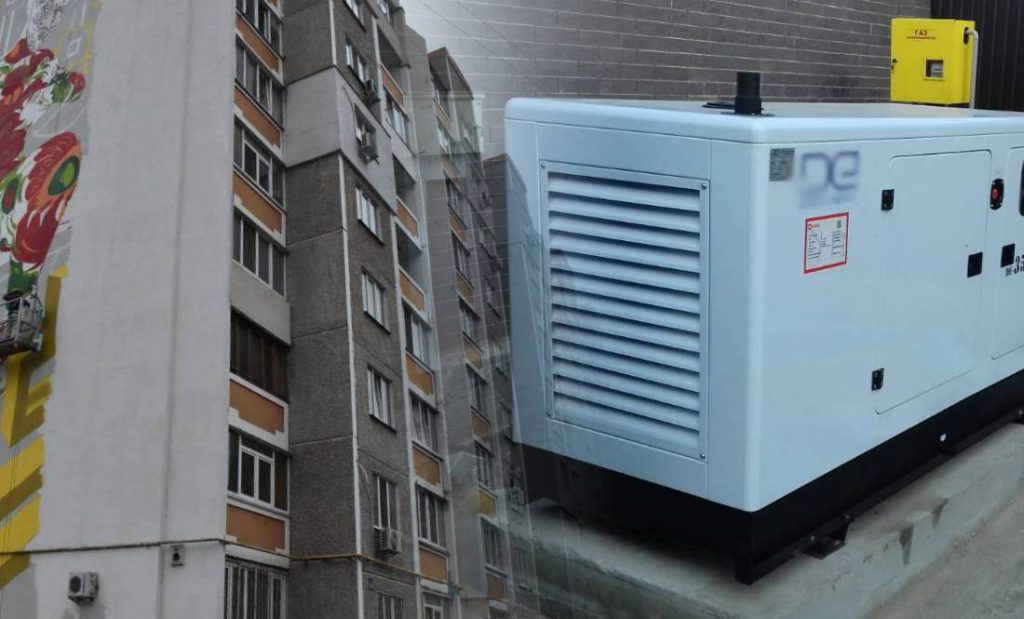
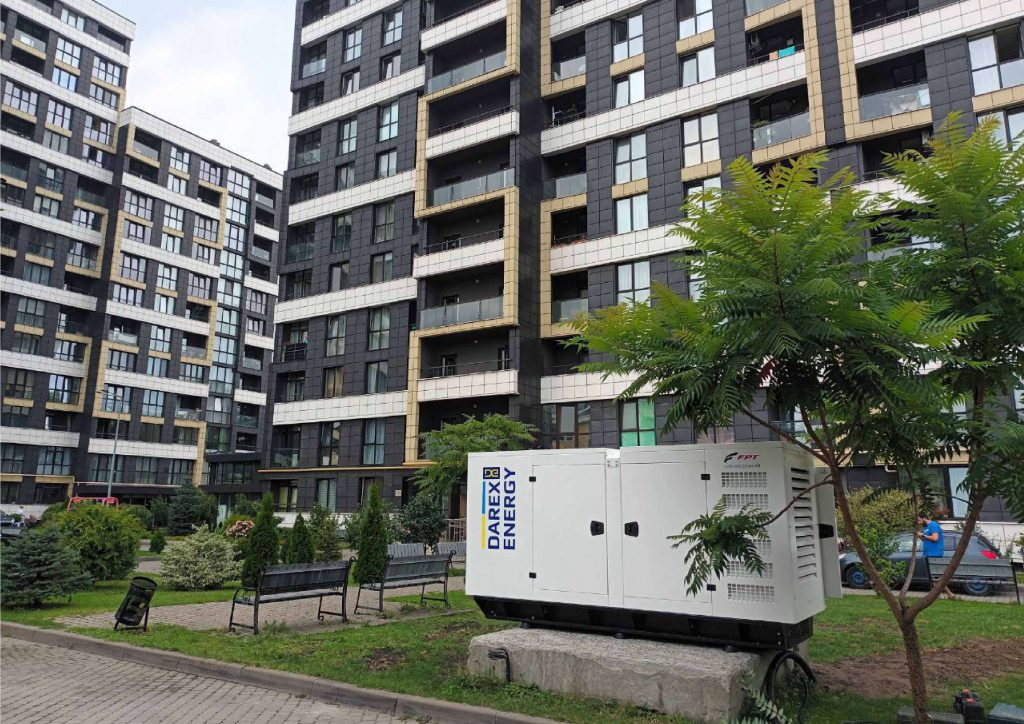
A dedicated outdoor equipment area
A specially designed generator room
A weatherproof sound-attenuated enclosure
A reinforced concrete foundation adjacent to the building
Proper installation should also provide:
Adequate ventilation
Safe exhaust gas discharge
Protection from weather conditions
Sufficient maintenance access
Restricted access for unauthorized individuals
Professional installation significantly extends the service life of the equipment.
How to calculate the required generator capacity
One of the most common mistakes is purchasing a generator with excessive capacity “just in case.” An oversized generator operates inefficiently, while an undersized unit may fail to support the required electrical load.
Before selecting equipment, specialists perform an energy assessment of the building, identify all critical electrical systems, and account for the startup currents of elevators, pumps, and ventilation equipment.
This approach provides the best balance between equipment cost, fuel efficiency, and long-term reliability.
Maintaining a backup generator
Even the most advanced generator requires regular preventive maintenance. Routine service includes checking engine oil, filters, batteries, the cooling system, fuel system, and electrical components.
It is also recommended to perform scheduled load tests. Regular testing helps identify potential issues before an emergency occurs and ensures that the generator will operate reliably whenever backup power is needed.
Today, backup power has become one of the most important elements of safe and reliable apartment building operation. A properly selected generator keeps elevators, water pumps, security systems, and emergency lighting functioning even during prolonged power outages.
For homeowners associations, investing in a high-quality generator quickly pays off by improving building safety, protecting critical infrastructure, and providing peace of mind for residents. When the equipment is professionally selected and correctly sized, a backup power system can deliver dependable performance for many years while ensuring the building remains operational under virtually any circumstances.
How to choose a reliable generator supplier in Ukraine
When electricity is essential for the uninterrupted operation of a business, production facility, office, or private home, a generator becomes more than just additional equipment — it becomes part of the power supply system. The reliability of the generator affects equipment operation, product safety, people’s comfort, and even the safety of certain processes. However, choosing […]
Generator for a farm: key selection considerations
For a farm, electricity is not just a matter of comfort but an essential condition for stable operations. Pumps, ventilation systems, refrigeration equipment, lighting, automation systems, grain dryers, and other machinery can operate only with a reliable power supply. A prolonged power outage can disrupt production processes, lead to product spoilage, and cause financial losses. […]
How to choose a generator for a private house with solar panels
Solar panels allow a private house to partially or fully cover its electricity needs without constant dependence on the grid. However, even a well-designed solar power system has its limitations. At night, there is no solar generation, panel output decreases in cloudy weather, and in winter, daylight hours are significantly shorter. If electricity is needed […]



 Kyiv
Kyiv
