Generator for an Office: How to ensure uninterrupted business operations
Home >
Blog >
Generator for an Office: How to ensure uninterrupted business operations
For a modern office, electricity is not just a matter of comfort but an essential condition for stable operations. Computers, servers, network equipment, security systems, air conditioners, lighting, and other devices all depend on a reliable power supply. Even a short power outage can result in data loss, interrupted workflows, or disrupted communication with customers.
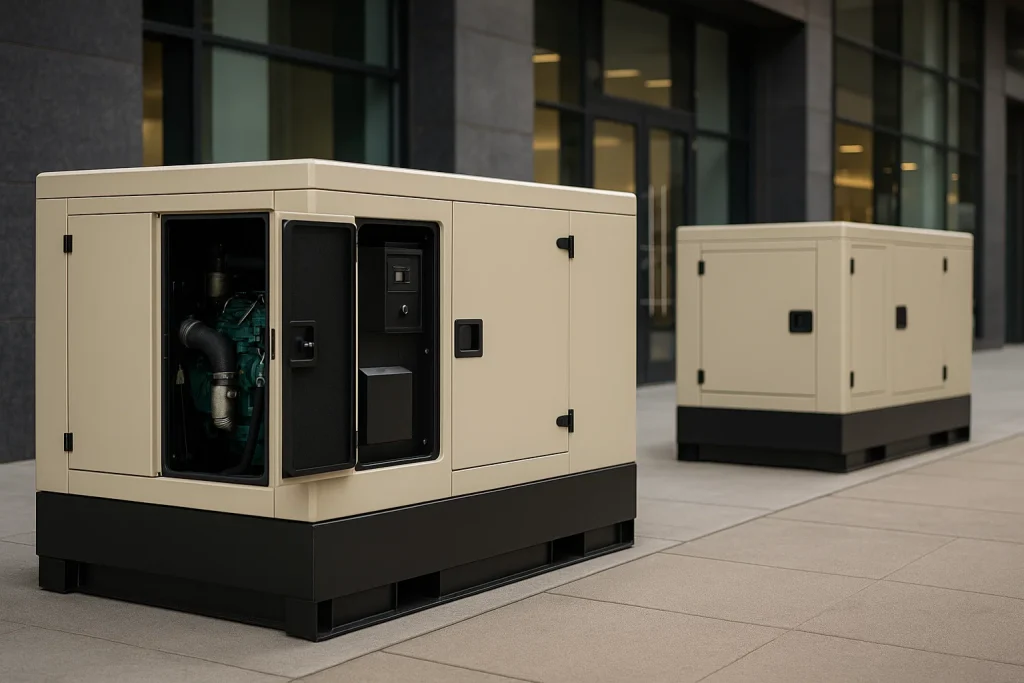
That is why a backup power source has become an important part of a company’s infrastructure. One of the most reliable options is a diesel generator for an office. It can be started manually or automatically when the power goes out, allowing the company to continue operating regardless of the condition of the main power grid.
Why does an office need a generator?
At first glance, it may seem that a small gasoline generator is enough for an office. However, this option is not always suitable for continuous or extended operation. If a company has a server room, many workstations, a powerful air conditioning system, or other energy-intensive equipment, the total load can be substantial.
A diesel generator offers several advantages:
designed for long-term operation under load;
high fuel efficiency;
can be used as a primary or backup power source;
provides stable power for equipment;
available in a wide range of power capacities;
can operate together with an automatic transfer switch (ATS).
For a business, this means fewer disruptions and the ability to keep critical processes running even during emergency power outages.
How to determine the required generator capacity
One of the most common mistakes when choosing a generator is focusing only on the number of outlets or workstations. In reality, you need to calculate the total load of all equipment that must remain operational during a power outage.
The list should include:
computers and monitors;
servers and network equipment;
video surveillance systems;
security and fire alarm systems;
lighting;
air conditioning and ventilation;
refrigeration equipment, if applicable;
office equipment;
electric access control systems and other critical equipment.
At the same time, the generator should not be selected to match the calculated load exactly. A certain power reserve is necessary for stable operation and possible office expansion in the future.
It is especially important to consider the starting currents of electrical equipment. Some devices consume significantly more power when starting than during normal operation. Ignoring this factor can cause the generator to operate at its limits or become overloaded.
Diesel or gasoline generator?
For a small office with a minimal electrical load, a gasoline generator may be a suitable solution. However, if equipment needs to operate for several hours or longer, a diesel generator is often a more practical choice.
Diesel fuel enables efficient operation of powerful equipment, while diesel generators are well suited to prolonged loads. This is why industrial diesel generators are used not only in manufacturing facilities but also in large office buildings, commercial properties, medical facilities, logistics centers, and other locations where interruptions in power supply are unacceptable.
Engine durability is also an important factor. With proper maintenance, a high-quality diesel generator can remain a reliable part of a backup power system for many years.
Automatic start – an important advantage
For an office, a generator equipped with an automatic transfer switch (ATS) is particularly convenient. The principle is simple: the system continuously monitors the parameters of the main power supply. If the voltage disappears or falls outside the acceptable range, the ATS sends a signal to start the generator and transfers the load to the backup power source.
Once the main power supply is restored, the system transfers the load back to the main grid and shuts down the generator.
This eliminates the need for employees to start the generator manually. For offices that operate around the clock or have server rooms, this level of automation is especially important.
What to consider when installing a generator
Purchasing a generator is only part of the process. Proper installation and operation are equally important.
Before installation, it is necessary to determine the appropriate location for the generator. The site must provide sufficient ventilation, safe exhaust gas removal, convenient access for maintenance, and safe fuel storage. Powerful models are often installed in a dedicated room or a special container.
The generator must also be correctly connected to the electrical system. The connection scheme should take into account the type of load, number of phases, generator capacity, and operation of the ATS.
It is not advisable to connect a powerful diesel generator without the necessary technical expertise. Installation errors can pose risks to people, equipment, and the electrical system itself.
Generator maintenance: Why it should not be neglected
Even a high-quality generator requires regular maintenance. First of all, the engine oil level and condition should be monitored, filters should be replaced on time, and the cooling system, battery, fuel system, and other components should be inspected.
It is also important to start the backup generator periodically even when there are no power outages. This helps identify potential problems in advance and ensures that the equipment will be ready when it is actually needed.
For a business, preventive maintenance is much less expensive than an unexpected shutdown caused by generator failure.
How much does an office generator cost?
There is no universal price for a backup power plant. Generator prices depend on the power capacity, engine type, configuration, automation system, manufacturer, noise level, and other specifications.
Choosing the cheapest model is not always the best decision. If the generator is intended as a backup power source for a server room, large office, or other critical facility, reliability, service life, operational stability, and access to professional maintenance should be among the main selection criteria.
It is also important to consider not only the initial equipment cost but the total cost of ownership, including fuel consumption, maintenance, replacement of consumables, and potential repairs.
How to choose a generator for a specific office
Before purchasing a generator, it is worth answering several questions: What power capacity is required? How many hours should the generator operate continuously? Which devices are critical? Is an automatic start system required?
If the company plans to expand, it is advisable to provide additional power capacity. This makes it possible to connect new equipment without replacing the entire backup power system.
It is also important to determine whether the entire office needs to be powered or whether only critical systems need backup power. For example, servers, network equipment, lighting, and security systems can remain connected to the backup source, while non-essential consumers can be switched off during an emergency.
A backup generator is not simply a piece of equipment used in an emergency. For a company, it is a risk management tool. Autonomous power supply allows a business to continue operating, maintain access to data, communicate with customers, and keep critical processes running.
Properly selected capacity, professional installation, automatic transfer, and regular maintenance turn a diesel generator into a complete backup power system.
If a company wants to minimize its dependence on power grid interruptions, the generator should be selected based on more than price alone. Load requirements, operating conditions, installation requirements, and future business growth should all be taken into account. This approach makes it possible to choose a reliable solution that will perform when it is needed most.
How to choose a reliable generator supplier in Ukraine
When electricity is essential for the uninterrupted operation of a business, production facility, office, or private home, a generator becomes more than just additional equipment — it becomes part of the power supply system. The reliability of the generator affects equipment operation, product safety, people’s comfort, and even the safety of certain processes. However, choosing […]
Generator for a farm: key selection considerations
For a farm, electricity is not just a matter of comfort but an essential condition for stable operations. Pumps, ventilation systems, refrigeration equipment, lighting, automation systems, grain dryers, and other machinery can operate only with a reliable power supply. A prolonged power outage can disrupt production processes, lead to product spoilage, and cause financial losses. […]
How to choose a generator for a private house with solar panels
Solar panels allow a private house to partially or fully cover its electricity needs without constant dependence on the grid. However, even a well-designed solar power system has its limitations. At night, there is no solar generation, panel output decreases in cloudy weather, and in winter, daylight hours are significantly shorter. If electricity is needed […]




 Kyiv
Kyiv
